


To some, it may seem over the top, but to others, it’s necessary. This year, Bauer has launched their own collection of protective women’s hockey gear, the Vapor FLY-W, along with the FLY-G series for developing players. In this article, we’ll take a close look at this new equipment line and exactly why it all matters.
Finding the Right Fit
Vapor FLY-W: Bauer's First Full Women's and Girl's Protective Line
The Vapor FLY-W and Fly-G lines mark Bauer’s first significant entry into the women’s protective market. This gear includes shoulder pads, elbow pads, shin guards, and pants.
The biggest hurdle with women’s hockey gear stems from a lack of or failed fit. Although women are fully capable of wearing standard “unisex-marketed” gear (and the same with men wearing women’s gear!), it’s both much more comfortable and considerably safer to wear gear that fits you and your body shape. At the same time, gear like this can’t just be designed with a “Pink it and Shrink it” framework, especially with the nature of hockey. With the physicality and speed of the game, if you are using ill-fitting gear, you could lose a lot of protection, balance, and speed while skating.
Simply, it’s just not as safe or efficient to wear gear that does not fit right. This new release looks to address that issue. Bauer now has a gear line that has been completely redesigned to fit women better than ever.

Shrink it and Pink It
I've talked about this issue in a good number of other articles about women's gear. Essentially, this is when a company creates a women’s cut of a unisex or men’s cut clothing item by shrinking and making it pink. Additionally, merely making a product smaller and adding pink won't fit everyone. This marketing strategy is usually done with very little other design planning, and rarely consulted with women themselves. As implied, this would not work in hockey, where the fit in nearly all aspects of your gear is crucial to avoid injury.
Many hockey companies today prioritize fit just as much as, if not more than, cost and technology. It’s not merely enough just to shrink it and pink it, in the same way that it’s not enough to design Junior-size skates only for younger players. Bauer's creation of their own line of women’s and girls’ hockey gear is a step in the right direction for the development of the sport.

Vapor FLY-W Equipment and Technology
Shoulder Pads
Shoulder pads tend to be one of the toughest protectives for women to find the right fit for. Most avoid bulkier, more protective choices in favour of lighter, airier options. But these may still not fit right, especially in the chest and shoulder areas.
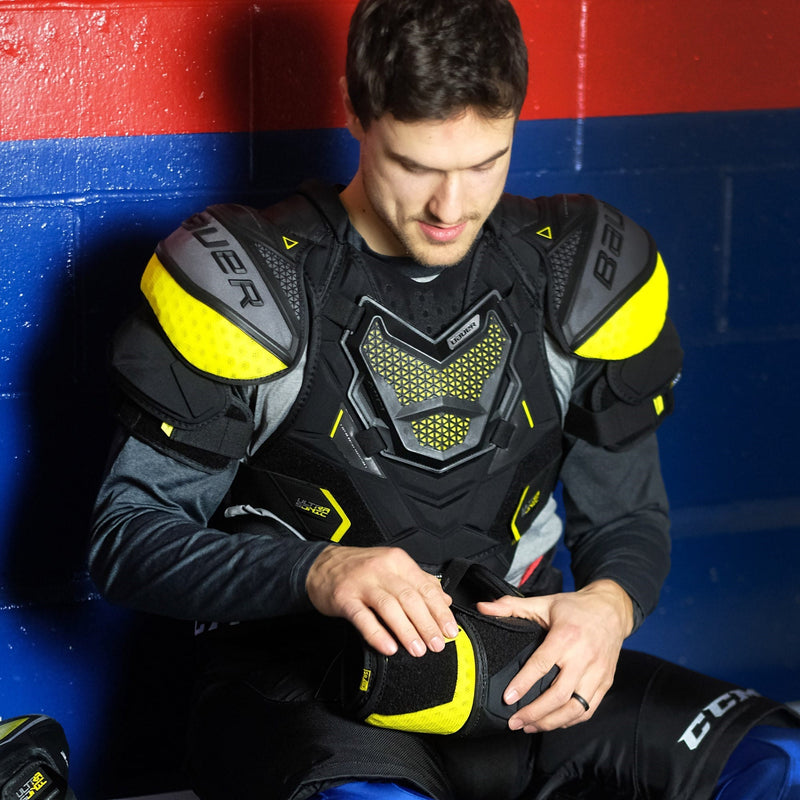
The FLY-W shoulder pads have been completely revamped, now with a more snug bicep fit and low-profile shoulder caps that fit farther down on the pad. The sternum is designed with a sleek profile, so it feels less bulky but still adapts to your movements, keeping you protected throughout the game.
The vest includes a molded chest area and low-profile ribs for unrestricted mobility and no added bulk. You’ll probably also notice some extra triangle-shaped padding on the sides, just above the ribs, to redirect the pad shape a little outward and allow for more comfortable contouring around different chest sizes. You can then customize that shape as well, using the added adjustable lace closure.

Elbow Pads
Elbow pads are notoriously hard to fit for every hockey player; get the wrong size, and they could slip down your arm after every shift, cut off circulation, or hinder mobility. They could also just be flat out uncomfortable to wear. If elbow pads are already awkward for male hockey players to find the right fit for, you can imagine how it might be for women as well. The FLY-W looks to change that.
These pads share the shoulder pads’ low-profile, women-specific shape, noticeable in the elbow cap and forearm shields, with a shortened forearm to better match a woman’s arm proportions. The comfort sleeve along the inside, coupled with the Dynaflex strap, holds the pads in place while allowing a more personalized fit.

Shin Guards
Shin guard fit is a lot more important than we may realize. Yet another piece of equipment that women prefer with a low-profile design, but that should still fit naturally along your shin. Unfortunately, standard shape shin guards don't always cut it for many female players, especially since women's shins and knees differ greatly in shape compared to men's.
The issue is bigger than comfort. Many female players sacrifice length or protection for a closer fit, or even just to have shin guards that fit under their hockey socks—another piece initially designed for male proportions. In general, ill-fitting shin guards can cause major problems for female players, as they are four to eight times more likely to tear their ACL compared to their male counterparts. This isn't new information; in fact, the documentation on knee issues in women's athletics has spanned decades. Once female players hit puberty or are going through certain phases of their cycle, hormones affect ligament laxity (looseness), increasing the chance of knee injuries.

The best way to combat this is with properly fitting gear, notably shin guards.
The FLY-W shin guards have been reworked to better fit women’s shins, so they don’t have to go down a size or sacrifice protection for a better feel. They include a deeper knee cap and slightly bowed shape to accommodate a larger Q-angle in the hips and knees, coupled with a dual-lock anchor strap system to hold the pads in place. The X-LITE shield shin cap is lightweight and helps provide elite protection and mobility.

Pants
Hockey pants are a particular set of gear that can be difficult to design for a woman’s body shape, in part because women’s lower bodies tend to vary significantly more often in shape than men’s do. The FLY-W pants feature a tough, independent HD spine, shaped strategically to protect key areas around your lower back. The independent nature also means the spine moves and adjusts with you and your body shape, and while you're skating.
The pants also include other fitting changes, allowing you to customize them as needed to fit perfectly around your specific body shape. The forward-flex closure allows for some adjustment in the front, making it easier to lean forward as you skate and prep for the faceoff. Around the hips is an adjustable one-piece hip guard, a traditional-style guard that you can change to fit just right around your body.
Another common issue that female players tend to come across is pant length. To ameliorate this, the FLY-W includes an extension fit design, allowing for adjustment up to one inch (2.5cm).
Nanosense Liner
All parts of this gear set use Bauer’s NANOSENSE liner along the interior of the padding. This liner is designed to feel smooth and cool where the gear touches your body, mitigating any scratching, abrasions, or chafing that could occur while playing. NANOSENSE is also coated in an odour-managing treatment to keep your equipment feeling and smelling fresh for longer.
Vapor FLY-G Gear
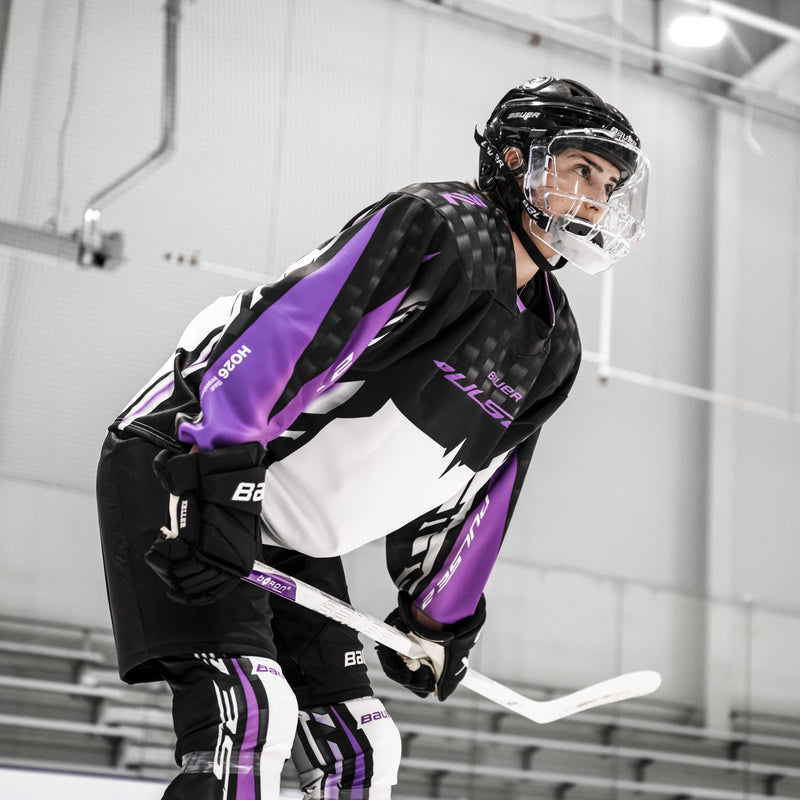
Fly-G is a variant of the FLY-W designed for developing female hockey players, featuring a slightly different colourway and modified design.
These pads come in a primarily light purple colour scheme. The combination of light purple with white and black is flashy, while also letting kids show off their boldness, creativity, and drive to be the best player they can be.
In terms of fit, the elbow pads still include that comfort sleeve along the inside (in a fun purple design too), along with a modified strap system along the forearm that’s a bit easier for younger players to lock themselves in with by themselves.
The shoulder pads have a smaller chest that does not include the added adjustment straps, for a simpler design. However, that doesn’t mean it's simply the same as any other chest pad. The front padding is still cut and contoured to fit closely around female players as they grow, so it will fit snugly and comfortably throughout each upcoming season.
The pants use both a skate lace closure and a pant belt for a more personalized, all-around fit. Along the back of the shin guard, the calf guard is designed a bit softer and more pliable than the FLY-W, offering comfort in addition to solid protection.

Developing Players, Shin Guards, and Knee Safety
The chance of knee injuries increases once children reach around ten years old, and the spike is much higher in girls. A combination of anatomy (smaller ACL, wider pelvis, looser knee ligaments) and hormone differences/changes means it is imperative that young players get shin guards that fit properly as soon as possible.
For developing female athletes, knee protection is especially critical. Once puberty begins, hormone changes and physical growth directly affect knee alignment and ligament stability. These changes in the body can make knee injuries much more likely, especially in high-intensity sports like hockey. But this shouldn’t be a disadvantage; it’s why the FLY-G gear, designed similarly to the FLY-W, is also made with deeper-set knees to accommodate growing knees and help reduce that risk.
See Further Reading for more research and articles on female athlete development.

Final Thoughts
As a female athlete who grew up using whatever equipment was available, seeing more manufacturers finally create tailored equipment from scratch for women and girls is, frankly, amazing to see. I’ve dealt with knee injuries since I was twelve, and though medical professionals did warn my parents and me that spikes in knee injuries were common among female athletes around that age, I was never taught why or how it could occur. So I continued with the gear I had—with very little variance. Knee injuries, when they happen once, are recurring, and unfortunately, my knee injuries after the first never really got better.
Now, with more female athletes climbing the ranks in professional and recreational hockey, it’s becoming even more important to make sure those players are getting the gear that fits them right, and as early as possible. Having accessible, properly fitting gear is integral for players to both play at their best and avoid injury. Making that gear available for female players is a huge step in the right direction.

Further Reading
Bose, Dipan et al. “Vulnerability of Female Drivers Involved in Motor Vehicle Crashes: An Analysis of US Population at Risk.” American Public Health Association, vol. 101, no. 12, pp. 2368-2373, Dec. 2011. Source Link.
Damiani, Rachel. “How Puberty Can Impact Teens’ Knees.” UNC Greensboro, 11 Apr 2022. Source Link.
De Boer, Tara. “Athletes’ injury risk altered by menstrual cycle, research indicates.” CBC Sports, 14 May 2025. Source Link.
Hayes, Arthur. “Knee Brace for Women vs Men: Top Options & Differences.” Sleeve Stars, 18 Feb 2026. Source Link.
Iuliano-Burns, Sandra et al. “The age of puberty determines sexual dimorphism in bone structure: a male/female co-twin control study.” The Journal of Clinical Endocrinology & Metabolism, vol. 94, no. 1, pp. 1638-1643, May 2009. Source Link.
McQuerry, Meredith et al. “A Critical Review of Female Firefighter Protective Clothing and Equipment Workplace Challenges.” Research Journal of Textile and Apparel, vol. 23, no. 2, pp. 94-110, May 2019. Source Link.
Reuther, Karen Korellis. “Shrink it and Pink It: Gender Bias in Product Design.” Harvard Advanced Leadership Initiative Social Impact Review. 25 Oct. 2025. Source Link.
Schram, Ben et al. “Injury rates in female and male military personnel: a systematic review and meta-analysis.” BMC Women’s Health, vol. 22, no. 310, 25 July 2022. Source Link.
Schram, Ben et al. “Risk factors for injuries in female soldiers: a systematic review.” BMC Sports Science, Medicine, and Rehabilitation, vol. 14, no. 54, 2022. Source Link.
Veciana-Suarez, Ana. “Why ACL Injuries Are Rising in Female Athletes and How to Prevent Them.” Reviewed by Jennifer Horawski, M.D. University of Miami Health System: UHealth Collective, 27 Apr 2026. Source Link.
Wendland, Rebecca et al. “Biomechanical and physiological effects of female soldier load carriage: A scoping review.” Applied Ergonomics, vol. 105, Nov. 2022. Source Link.
Zhuang, Sophia. “Men and Women are Physiologically Unequal: An Equal Research Emphasis. Yale Scientific, 28 Nov. 2020. Source Link.



Leave a comment